You know what’s hard about being a special ed teacher? You want to fix things and you can’t. You can make things better, certainly. But the nature of a learning disability is that it cannot be cured. I find parent teacher conferences very emotionally taxing. I appreciate the parents’ input and insight so much but I also feel a real burden when the hard questions are asked like, ” What’s going to happen to my kid?” “Will she ever be caught up?”
Truth is I can’t answer those questions. Wish I could, but I am careful not to make promises that I cannot keep.
Another truth comes to me. I read a book about children with learning disabilities that were successful adults. The book studied these individuals and found that the common denominator for these kids was they each had a cheerleader in their life. Someone who never gave up hope and someone who kept encouraging. This was most often a parent but could also be a teacher or other trusted person.
I may get frustrated that I cannot “fix” things but I will continue to be a dedicated cheerleader.
Category Archives: Uncategorized
You Know What’s Hard About Being A Special Ed Teacher?
Google Docs
A tool that has been very useful to myself and my students is Google Drive. My students can create a presentation (similar to powerpoint) or a word document (similar to Microsoft Word) and share it with me. I can edit their work (mostly I help with spelling) anytime from any computer.
Students will make a presentation for their history class and share it with me. I can be at home or in my classroom and I can help them along or just read it, comment, and help the student feel more confident. I’ve worked with students even when they are at home and I am at school!
In addition to sharing with me, students will share with a parent. What a great way to work together! What a confidence booster for students!
If you have Gmail, click “Drive” at the top of the page to discover what you can do.
Here is a poster I put by our computers to help with shortcuts.
Try It! This Works!
Memorizing is tough, memorizing lists is tough! Memorizing is made easier by things like mneumonics (new-mon-ics). Mneumonics like HOMES for the Great Lakes (Huron, Ontario, Michigan, Erie, Superior) give our brains “a hook” to hang things on; a way to make sense of a list. The site www.braingle.com explains why our brains like mneumonics:
1. They make the material more meaningful by adding associations and creating patterns. In fact, mnemonics work better for material that is less meaningful.
2. They help organize the information so that you can more easily retrieve it later. By giving you associations and cues, mnemonics allow you to cross-reference the information in different parts of your memory. This mental structure is very useful for material that has very little inherent organization.
3. Mnemonics typically involve visualizations that help make the facts more vivid. This is especially helpful for people who are visual learners. Additionally, these visualizations help focus your attention on the material by making the learning more fun.
Memory aids that build links can be visual like this picture of an energy drink:

I made this with a student to help her remember the term “mitochondria” and to help her remember that the function of the mitochondria is to produce energy in the cell.
Another memory aid that builds connections for a student is narrative, or story. I taught students the capitals of the provinces of Canada in less than half an hour. Ham up the stories, the funnier the better, and the more memorable! For a copy of this, click here.
We tried another narrative. I put 10 items on a tray, students looked at the items for a minute, then I took the tray away. I asked them to write what they remembered. Next, I took out the tray and made a story in which I walked through my house and in each room I incorporated one of the items. For example, to remember: hat, tennis ball, book, juice box, sock, and calculator: I walked into my house and hung up my hat. Then I walked into the hallway and kicked a tennis ball that was left on the floor. I was frustrated so I went into the living room and sat down but I sat on a book. I quickly got up and went into the kitchen for a juice box. After that I went to the living room where I found my sock. I put it on and decided to get to work. I went into the dining room and sat at the table with my calculator. And so on… This method works best when your mental pictures are walking through rooms in your own house. Try it! Challenge someone that doesn’t know this trick and blow them away with your memory powers!
These tools are definitely NOT just for special ed. students! Imagine the university student that has to memorize the parts and functions of a cell, list genres of literature, rattle off events in historical order, or recall different types of generators and how they function!
Easy Peasy and So Helpful!
This week I taught my students this vocabulary word: ACCESSIBILITY
I explained that it is a gateway to getting somewhere that can otherwise be a challenge. Students took out iPads or iPods and looked to the setting for “Accessibility”. Once found, they turned on “Speak Selection”. Now, anytime browsing the web in Safari or looking at a word document they can highlight the text and one of the choices will be “Speak”. The text is read while individual words are highlighted.
This was exciting to all. I emphasized that “Accessibility” would be a part of their future technology and they had only to find and activate it. The gateway will be wide open! No more struggling to keep up reading a website that the teacher has assigned. One student was so excited, he immediately set it up on his iPod, went online and found the local newspaper, and started listening to articles that he could use for current events. Another student shouted, “I can’t wait to show this to my dad, he won’t believe this!”
No limits!
Click here for a copy of an instructional handout that I will present to my staff.
Link Between Childrens’ Lack of Sleep & Brain Power
“link between poorer mental performance and lax bedtimes”
Late nights ‘sap children’s brain power‘
I read this study and wanted to say, “Thank you Captain Obvious!” (My kids taught me that 🙂
Through the summer I find it somewhat amusing to observe what lack of sleep and lack of a regular routine does to my own children. One of my children is like a young puppy – getting randomly hyper and racing around and then needing to veg on the couch watching TV. Another one of my children shows a diminished speech filter and can become highly critical. I’ve seen episodes of dippiness (i.e. milk in the cupboard), a short temper, a lack of creativity, an inability to remember multiple instructions, trouble listening, hanging around / unmotivated, lack of focus, impulsive behaviour and uncontrolled giggles. All could look like symptoms of ADD or ADHD (Attention Deficit Disorder or Attention Deficit Hyperactive Disorder). Hmmmmm.
Don’t get me wrong. Summer is so much fun for our family! I love the lack of routine and less strict bedtimes but they will have to remain summer activities for my kids.
What’s On Your List of Awesome?
In about May, as the weather begins to change, the sun is shining longer, kids probably get less sleep, I notice a downward slide in motivation and an upward climb of negative emotions (in both my own children and my students).
This year to help with these “I can’t wait until summer blues” we read portions of 1000 Awesome Things.
I love the idea of finding joy in the small things. I showed my students the list of awesome that my own family had put together after reading The Book of Awesome. So many small things to be thankful for!
So what’s on your list of awesome? Here are some of my favourites right now:
Emotions and Learning – Be a Cheerleader!
EMOTIONS CAN MAKE US SMARTER. We sometimes give short shrift to emotions when we’re talking about academic success, but the science of learning is demonstrating that our emotional state represents a crucial internal situation that influences how intelligently we think and act.
When we’re in a positive mood, for example, we tend to think more expansively and creatively. When we feel anxious—for instance, when we’re about to take a dreaded math test—that anxiety uses up some of the working memory capacity we need to solve problems, leaving us, literally, with less intelligence to apply to the exam.
One line of investigation within the science of learning has to do with the feeling of hope. Research in this area has found that a feeling of hopefulness actually leads us to try harder and persist longer—but only if it is paired with practical plans for achieving our goals, and—this is the interesting part—specific, concrete actions we’ll take when and if (usually when) our original plans don’t work out as expected.
Great Ideas Come From Pinterest
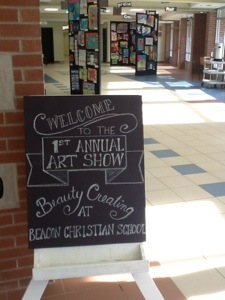
I love Pinterest when I have plenty of browsing time. This week a Pinterest idea from a middle school art blog came to life at our school and I think it is fantastic! Best of all is that these boards are so light weight and you only need a few pins to attach things. I can see them being used for so much more than an art show.