Category Archives: Kids

Link Between Childrens’ Lack of Sleep & Brain Power

“link between poorer mental performance and lax bedtimes”

Late nights ‘sap children’s brain power

BBC News Health

I read this study and wanted to say, “Thank you Captain Obvious!” (My kids taught me that 🙂

Through the summer I find it somewhat amusing to observe what lack of sleep and lack of a regular routine does to my own children. One of my children is like a young puppy – getting randomly hyper and racing around and then needing to veg on the couch watching TV. Another one of my children shows a diminished speech filter and can become highly critical. I’ve seen episodes of dippiness (i.e. milk in the cupboard), a short temper, a lack of creativity, an inability to remember multiple instructions, trouble listening, hanging around / unmotivated, lack of focus, impulsive behaviour and uncontrolled giggles. All could look like symptoms of ADD or ADHD (Attention Deficit Disorder or Attention Deficit Hyperactive Disorder). Hmmmmm.

Don’t get me wrong. Summer is so much fun for our family! I love the lack of routine and less strict bedtimes but they will have to remain summer activities for my kids.

20130711-145355.jpg

A Card for Many Signatures

20130627-094443.jpg
Another card for a valuable volunteer! I don’t know what our school would do without these dedicated individuals!
(Our words of thanks are written around the bow.)

Re: Time

20130623-203309.jpg
There is a time for everything under the sun. King Solomon said that. Summer is time to recharge and rejuvenate. Although I know they need a break, I long for my students to review. I fear the backslide after they have worked so hard to get to where they are.
Three suggestions for summer review:

1. Do it regularly so that it becomes “no big deal”, just part of the daily routine.

2. Review should be at a level that it can be done independently. You, the parent, are the enforcer, making sure it happens, but kids should be able to do it without you. In my house a math page and a French activity must be done before screen time. Since my kids want screen time, they make sure to get their work done.

3. Give your kids the option of just going to bed OR going to bed and reading for twenty minutes. Kids will say, “Can I just go to bed later?” You say, “No, you can go to bed now with reading or without, but you go to bed now”. My reluctant reader always chose reading in this scenario! Soon he was into a book and was seen picking it up during the day too!

I am looking forward to renewing my focus and reflecting on my year. I hope my students take time to remember their achievements and solidify their learning.

Emotions and Learning – Be a Cheerleader!

All Kind of Minds Newsletter:

EMOTIONS CAN MAKE US SMARTER. We sometimes give short shrift to emotions when we’re talking about academic success, but the science of learning is demonstrating that our emotional state represents a crucial internal situation that influences how intelligently we think and act.

When we’re in a positive mood, for example, we tend to think more expansively and creatively. When we feel anxious—for instance, when we’re about to take a dreaded math test—that anxiety uses up some of the working memory capacity we need to solve problems, leaving us, literally, with less intelligence to apply to the exam.

One line of investigation within the science of learning has to do with the feeling of hope. Research in this area has found that a feeling of hopefulness actually leads us to try harder and persist longer—but only if it is paired with practical plans for achieving our goals, and—this is the interesting part—specific, concrete actions we’ll take when and if (usually when) our original plans don’t work out as expected.

ADHD – Is North America handing out a pharmacological band aid?

Most parents I meet do not want to medicate their children. Most teachers do not want medicated students. However, there are still some obvious behaviours to deal with.
I thought this was an interesting article shared on Facebook about the North American diagnosis of ADHD vs the French diagnosis of ADHD.
In France doctors look at the underlying social and contextual causes. Nutritional causes are examined and parenting styles are also said to produce better behaved children. I think they are onto something – ‘très bien’!

Open Doors

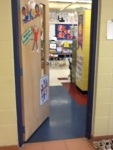
20130503-185106.jpg
When I was a very young teacher I remember a day when I had a substitute teacher teaching my class because I had a doctor’s appointment. Upon my return I noticed two things: first, that the classroom door was open and, secondly, the substitute was speaking to my students in a tone that I judged to be harsh and impatient. I remember thinking, “What if a parent walked through this hallway right now?”

Since that day, this memory has challenged me to leave my classroom door open as often as a I can. An open door serves as a physical reminder that we need to be accountable.

Sometimes I get too loud in my storytelling or the classroom next door is too loud and we close the door, but I believe that a parent should be able to walk down a hallway at any time and smile.

Sitting. Still??

20130409-225242.jpg
I was waiting in a waiting room when I picked up a Macleans magazine and read the article Why Sitting is a Dangerous Health Threat.
Interesting!
The article talks about changing our workplace culture to include and even expect walking and standing breaks. We ALL need these breaks!
What a great challenge – not only to get our kids and students moving more but also to get up off our seats and really get involved!

Anchor Charts

Anchor Charts are charts that teachers (or parents) and students create together to provide students with a visual reminder of the lesson taught. Anchor charts serve as a reference for students, helping them become more independent in a task.

This weekend I googled “Math Anchor Charts” and found this site. Lots of ideas here:

Math Anchor Charts

Although my students did not help me create them, they do echo the lessons and words we have used. I made these (even fixing a mistake I found on the link’s “Adding Fractions” chart):

20130112-200709.jpg

I also wanted to create something that demonstrated all four operations of fractions in one place:

20130112-195627.jpg

Anchor charts can be used at home too. I have made them as a reference of what to put in a lunch, a friend of mine has one hanging in her mudroom to remind her children of the “getting home and putting away shoes, coats, backpacks and lunches” routine. In my classroom I made an anchor chart with a sequence of photos to make physiotherapy exercises a more independent routine.

20130112-201202.jpg

Anchor chart – a very useful and visual tool.

Cell Phones

Yup, my kids have cell phones. I got them cell phones to alleviate my anxiety. As they get older and are off doing all kinds of activities without me, the cell phone allows me to still “be there”.
However the cell phone world is not as magical as I imagined it to be. I imagined my daughter texting me while babysitting and my son giving me a play-by-play when he joined a new youth group that he was nervous about. This is not my reality. My reality is kids disappearing in their room to text their friends, phones turned off or on silent when I really need to call, messages left for friends late at night, texting at Grandma’s when they should be socializing and extra charges for extra usage.
Cell phones, tablets, iPads, X-Box, have all created new parenting territory.
My husband and I are not always sure how to navigate this new territory. We have rules but every once-in-a-while we need to reign in the kids and reinstate or change some of the guidelines.
I came across this cell phone contract today at: Cell Phone Contract. I am only adding one thing: text me when you change locations or have been away for a significant amount of time. I have already printed a copy of the contract: Our Family Phone Contract
Time for another family meeting 🙂

Jobs Around The House

I want my children to do jobs for several reasons:
(a) because they are part of a family and family works together
(b) to teach them that things don’t “clean up themselves”
(c) to teach them responsibility instead of taking things (and me) for granted
(d) to keep MEfrom getting annoyed that everyone is playing and making a mess while I work my butt off

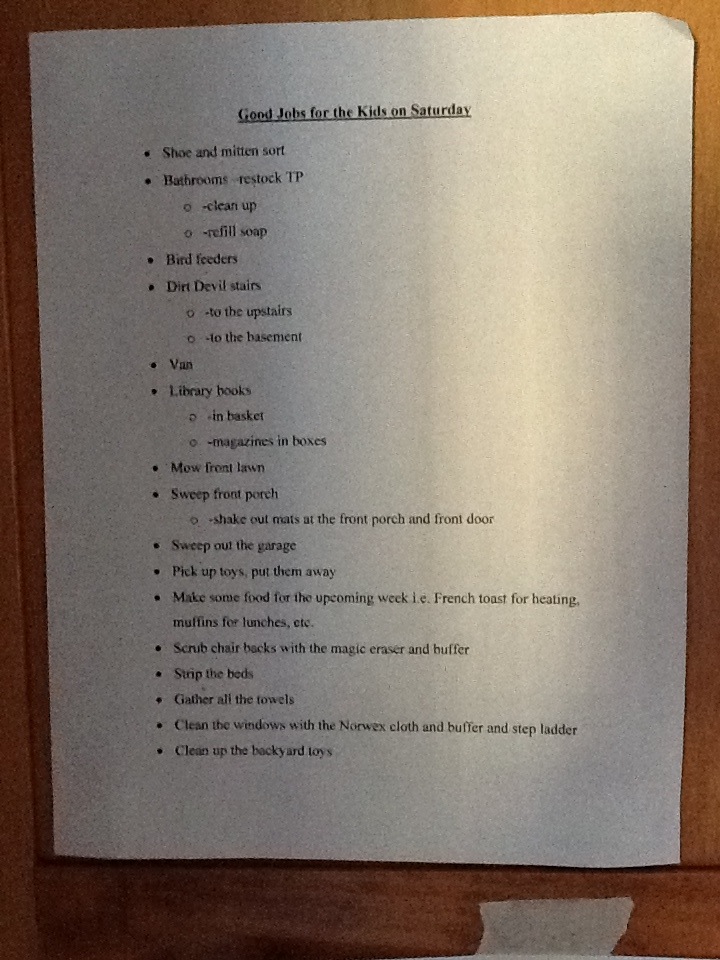
This is a list I’ve kept in my cupboard (taped inside the door) with ideas for regular jobs that the kids can do. Now that the kids are older they have daily jobs. I keep the jobs separate from allowance, I want them to help for the above reasons, not for monetary reward.

20121016-180013.jpg