Every once in a while I ask my students how things are going with their classmates. I ask them if anyone teases them about coming to the resource room. The last time I asked, a student said, “Why do you always ask us this?” I said, “I love you guys. It is my job to protect you as much as I can.”
I thought about that in the midst of all the heart wrenching stories coming from Connecticut. Teachers that hid students, teachers that read to students to calm them, teachers that told their students that they loved them.

Some teachers will react to the news in fear and extreme cautiousness. But as I look at our six year olds singing the Hallelujah chorus for our Christmas program, I just feel so grateful. Grateful to play a part in their lives. Grateful to be entrusted with these special gifts.
Author Archives: resourcefulresourceteacher
Through The Eyes Of Gratefulness
Try it First! Transition Words
We know we should take the time but we just don’t. Our explanations and lessons would be so much better if we did. We need to try activities before we ask our students to do them.
Many times an activity could have gone more smoothly if I had just tried it first.
I found this Christmas activity that I will ask kids to do in partners. It targets sight words and transition words. I tried it first myself to figure out strategies I would suggest for students that seem overwhelmed by the task. I think I will give students the title and some blank cards so that they can add words. I realized that I first picked out the transition words so I decided I will first teach a mini lesson on transition words and ask students to identify the transition words in their packet of words.
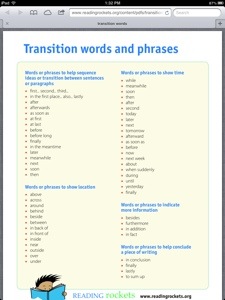


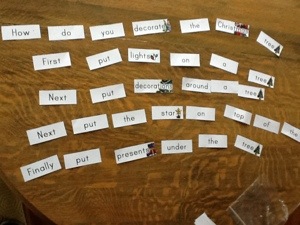
Trying the activity myself will definitely affect how I approach this lesson.
The activity is from an ESL site: Bogglesworld
The transition words chart is from Reading Rockets
Speech Therapy App
Another app. I like this one for articulation practice. You can choose a target sound and record the speech for instant feedback. You can choose whether the target sound will be in the beginning, middle, or end of the word. Best of all, it’s free!


Talking App
I love this app!


It’s a talking calculator and it has improved student accuracy on a calculator! So many of my students were not accurate with a calculator – pressing the wrong buttons. With this app they hear their mistake. When they do make a mistake they can backspace rather than starting all over. Love the multi-sensory approach.
I love using this app. It has improved my speed, accuracy, and confidence in my calculations.
The app is free but adding the voice costs a bit. Also, be sure to have headphones if others are around.

The Sentence Police
It can be difficult to provide students with the necessary repetition of a concept while keeping it fun and motivating. This is one way I’ve tried to rev up our editing every once in awhile.
 I wear the hat (I know, I am weird) and hand out tickets. As students fix their errors they hand the ticket back. It keeps us laughing about mistakes but also attentive to details.
The tickets say “Capital Offense,” “Omission Error,” “Punctuation Violation ,” and “Spelling Infraction.”
Ticket Out The Door
I like to keep things cyclical – remind kids regularly of things we have learned. It is good for bringing information from short term memory to long term. The problem is that I don’t remember what to ask about!
The solution is the “ticket out the door”. Most days, as we work on something, I put a key concept on a small recipe card (I keep a stack nearby). The card gets added to an envelope with other recipe cards from previous lessons. The envelope is right next to the door. As students leave, I draw a card and they must answer the review question. Sometimes they must all answer the same question (whisper the answer to me), sometimes I ask each person to give me an example of the concept i.e. “everyone give me an example of a synonym before you leave”, and other times I draw one for each student ( a great review, too, for the others who hear all the questions and answers).
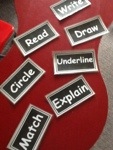
Today I put two more envelopes by the door. These are words I word like students to regularly review. I will sometimes use these as the tickets out the door.

Here are the words in these particular envelopes:

Strategies
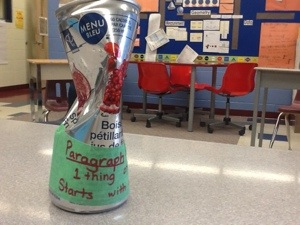
Students that struggle are often not using the appropriate strategies – strategies that good students utilize naturally. I made this toolbox so that I could display the appropriate strategy for the given activity.
I want students to see that different activities require choosing a different strategy.

Turtle Talk
I am constantly thinking about how to isolate a skill. Turtle Talk has helped me isolate the blending skill for early intervention and then the idea grew to help with so much more.
The idea started with this book:
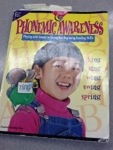
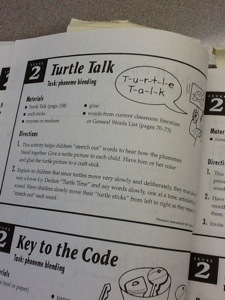
The idea is that the turtle talks so slowly that he only says one sound at a time.
Early intervention starts, for me, with games of oral blending. This isolates the blending skill. I ask if the child can understand turtle talk and I proceed to make the sounds of the word and the student blends them together. I often use different colour unifix cubes and point to each one as I make each sound so that the student also has visual reinforcement of different, separate, sounds. I start with short, 3 phoneme words, and build up from there.
“My turtle is so slow and tired. He can only say one sound at a time. Can you tell what he is trying to say? /c/ /a/ /t/”
The second step is asking the student to do turtle talk, perhaps with an “eye spy” game.
“How about you be the turtle and I will try to guess what your turtle is saying?”
Third, once the first two are well on their way to being mastered, I will ask a child to say a word in turtle talk and then ask which letter matches each sound and I will write each letter as they go through the process.
“What is ‘cat’ in turtle talk? What letter matches /c/? I will write it. What matches /a/?….”
Fourth, students do the turtle talk and try to match and write each sound independently.
As students get older I still refer to the turtle. To spell a word we will first count the individual sounds using turtle talk and then we will discuss how one sound might be spelled with two letters. I have found that this reminder helps activate the memory of phonics skills that they have acquired.
“Let’s do turtle talk to figure out how to spell ‘chair’. We hear 3 sounds – /ch/ /ai/ /r/.Two of the sounds are spelled with two letters. How do you spell /ch/? How would you spell /ai/ with two letters?…..”


 The Resourceful Resource Teacher