Category Archives: Math

Kinesthetic Learning

Kinesthetic learning is learning that takes place while the student engages in a physical activity.
Kinesthetic learning seems easier to incorporate in the learning of younger children but it is still vital to many older learners. Adding hands-on activities will enhance any lesson.

20121029-200424.jpg

Many adults or older students still need to have motion added to their learning – this can take unexpected forms. Motion can be added with gum chewing, pencil tapping, doodling, leg bouncing, walking, note taking, highlighting, role playing, or typing. Kinesthetic learners need activity breaks. Unfortunately, many times the need for activity and motion is treated as misbehaviour.

“Children enter kindergarten as kinesthetic and tactual learners, moving and touching everything as they learn. By second or third grade, some students have become visual learners. During the late elementary years some students, primarily females, become auditory learners. Yet, many adults, especially males, maintain kinesthetic and tactual strengths throughout their lives.”(Teaching Secondary Students Through Their Individual Learning Styles, Rita Stafford and Kenneth J. Dunn; Allyn and Bacon, 1993)

Read more on FamilyEducation: http://school.familyeducation.com/intelligence/teaching-methods/38519.html#ixzz2AjmTNRF3

Estimating and Rounding

Number sense seems to be a challenging concept for children with a disability in math. Rounding would seem a very useful tool but understanding how to round and visualizing whether to round up or stay the same can prove to be very difficult.

One thing that is important is to use consistent language while teaching the method of rounding.

Here is one example:

20121018-163629.jpg

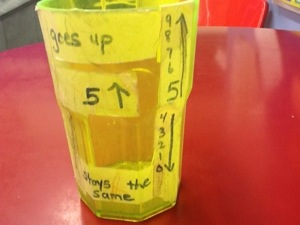
For some students I found consistent language and methods were not enough. This cup was an effort to make the concept visual. If the number is over five, the cup is closer to being full. As you can see, the cup was used a lot!

20121018-164045.jpg

Adding Nine

20121012-223020.jpg

20121012-223030.jpg

Multiplying by Nines

20121011-205244.jpg

The “trick” for nines.

Threes and Fours

20121011-200647.jpg

20121011-200656.jpg

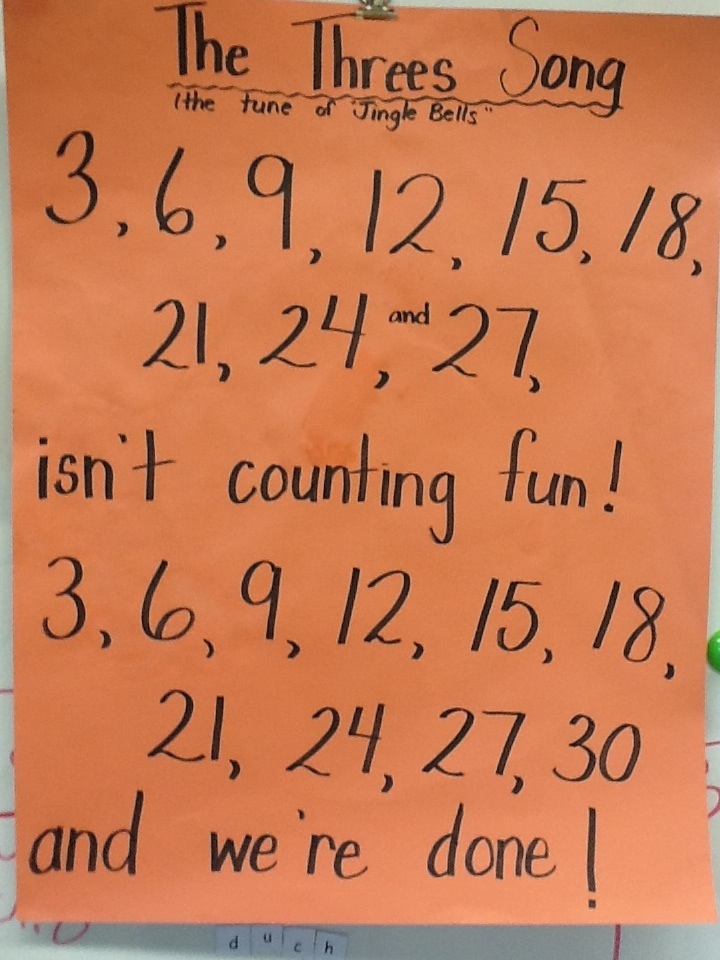
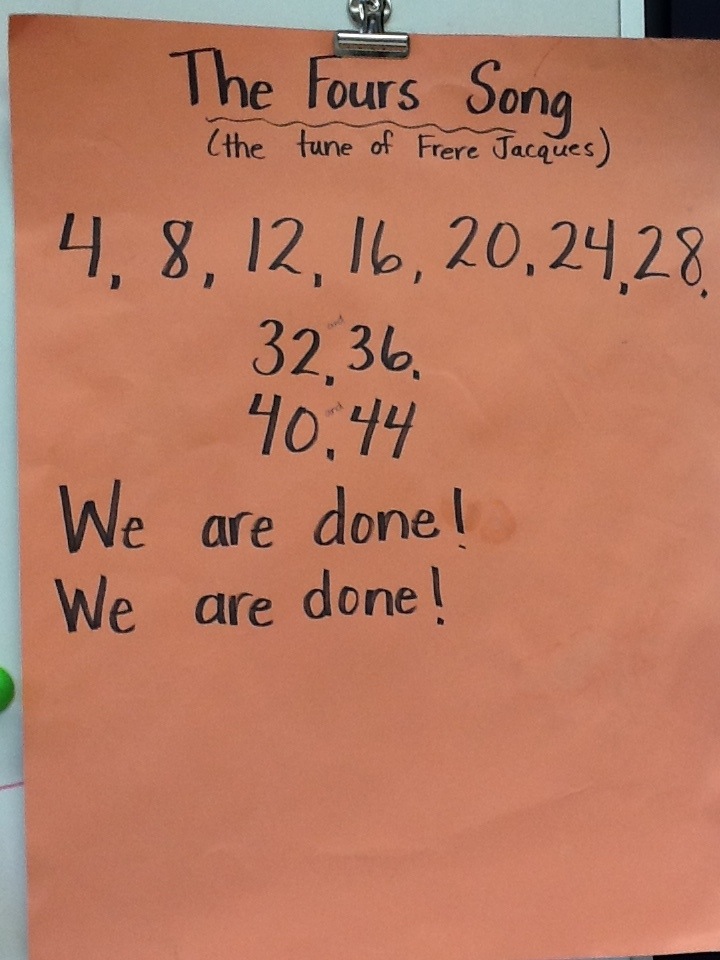
Thank you to a former student for teaching me these simple, but very helpful songs. (These really stick! They get stuck in my head!) What I like is that the first word in the song is the number you want to count by (rather than spending time trying to remember the words to the song).

Multiplication Facts

20121010-140441.jpg

20121010-140455.jpg

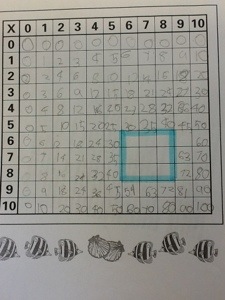
I call this “Pyramid Facts”. It was my way of making the memorization of multiplication facts more manageable and less overwhelming. First the students learn a song for counting by threes and a song for counting by fours as well as a “trick” for nines. Then the students and I fill in the “easy” facts on the multiplication grid. We know how to count by ones, twos, threes, fours, fives, nines, and tens so this goes rather quickly. What I love is that the students are always surprised by how much they know! There are only nine squares open on the grid that need to be memorized. Thanks to the commutative property of multiplication there are actually only six facts to memorize (7×8 is the same as 8×7). I call these six facts the Pyramid Facts. We spend time memorizing these and students begin to gain confidence in their ability to know the multiplication facts. (Remember that while learning these facts, students should begin by seeing the correct answer so that a correct mind picture forms. On my pyramid I put sticky notes. The students first practice by saying the facts aloud then I take the sticky notes off and they again say the facts aloud while replacing the answers.)

Math Anchor Chart

20120918-094403.jpg

Not sure where I got this idea but I have used it for different posters and charts – place paperclips through the poster. The paperclips allow information to be added or taken down and practiced. This anchor chart is used to highlight important terms in story problems. I added cards as my students came across them in their math work.